Projects
EVH Renovatie — A trade website built to get the phone ringing
- The search is local and specific. Nobody searches "renovation". They search for a product and a place — screens, roller shutters, a veranda, fly screens — which means one page per service, each able to rank on its own, beats a single services page with anchors.
- Trust is visual and immediate. A homeowner comparing installers is looking for evidence of finish quality. Photographs of completed work do more than any amount of copy, so the portfolio is a primary page rather than a footnote.
- The phone number is the conversion. Many customers will not fill in a form at all; they will call. So the number sits in the header on every page, permanently, tappable.
- The two requests are different. "I have a question" and "I want a price for this specific job" need different fields. Forcing both through one form loses the second, which is the valuable one.
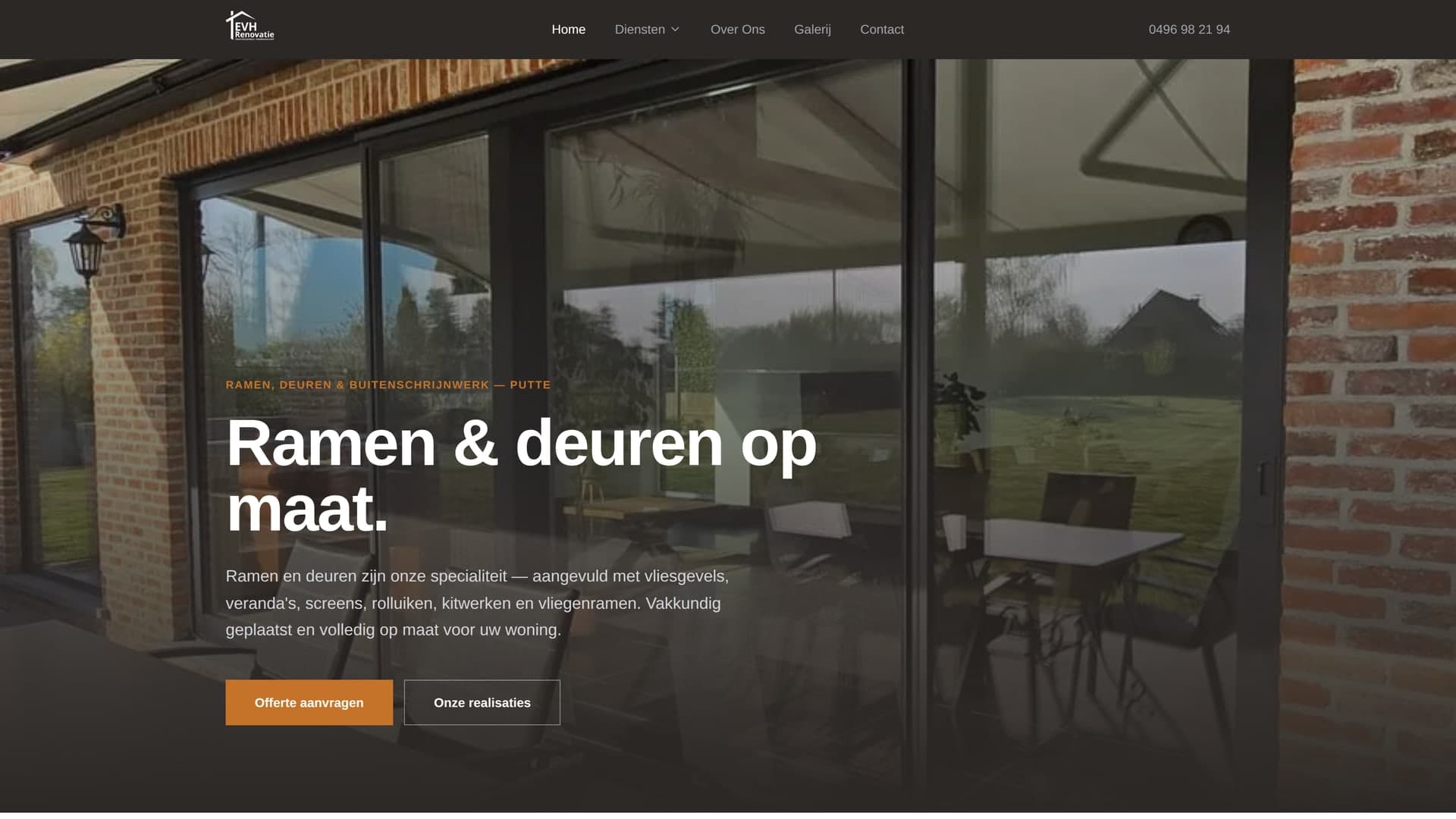
- Photography carries the page. A full-bleed hero of real installed work, shot on site, with the copy laid over it. The product is the craftsmanship, so the imagery is the argument.
- A warm, industrial palette: charcoal and a single construction orange for action. Restrained enough to read as professional, warm enough not to feel corporate.
- Plain, confident Dutch. Ramen & deuren op maat. No slogans, no filler. A trade customer wants to know what you do and where you do it, in the first sentence.
- Mobile-first, because the traffic is. Large tap targets, a header that keeps the phone number reachable, and forms that are short enough to finish standing up.
- Nine service pages — windows, doors, curtain walls, verandas, screens, roller shutters, sealant work and fly screens — each a real page with its own metadata and structured data, not a tab.
- Filterable portfolio: completed projects filtered by category, each with a photograph and a short description of the work.
- A two-mode contact page: a general enquiry tab and a full quote-request tab that captures the service, the location and the details an installer needs to price a job without a second phone call.
- Contact details as content: address, phone, email and opening hours laid out where a customer looks for them, not hidden behind a form.
- A self-service backend: submissions land in a database the client can read, alongside the portfolio projects and testimonials, so the site's content is theirs to change.
A React site that ships as static HTML. The site is built with Vite and React, but it does not ship as a client-rendered single-page app. A post-build step server-renders every one of the twelve routes and writes a static HTML file per route, with the complete head — title, meta, canonical, Open Graph and all the structured data — and the fully rendered body. The client then hydrates that same markup.
This matters for exactly the reason the site exists. A crawler or a social scraper with no JavaScript still sees correct metadata and real content, and a homeowner on a phone on mobile data sees the page immediately rather than a spinner. For a business whose entire acquisition channel is local search, shipping a blank shell to a crawler would have been the single most expensive decision available.
A backend the client can own. The content and form submissions run on PocketBase, a self-hosted backend that ships as one binary with its own admin interface. Collections for contacts, service requests, portfolio projects and testimonials are versioned as migrations. For a small business this is a better fit than a hosted content management platform: no per-seat cost, no vendor account to manage, and the whole thing is a file they own.
Hosting. The static build deploys to Netlify. Hashed assets get a one-year immutable cache, valid routes serve their own prerendered file, and unknown URLs fall back to the app shell. A retired page redirects permanently rather than 404ing, because a dead link that used to rank is a wasted asset.
- Frontend: React with Vite, React Router, Tailwind CSS, Radix UI primitives with class-variance-authority, Framer Motion for restrained transitions, Lucide icons.
- SEO: react-helmet for per-route metadata, a custom server-render and prerender pipeline, JSON-LD structured data, and a generated machine-readable site summary.
- Backend: PocketBase, self-hosted, with versioned collection migrations and rate limits configured.
- Images: Sharp for build-time image processing.
- Hosting: Netlify, with explicit cache headers and redirect rules.
A single-page app is the wrong default for a local business. The modern reflex is to ship a client-rendered app and add a meta tag library. For a site whose customers arrive from a Google search on a phone, that trades away the two things that matter most: what the crawler sees and how fast the first paint is. Building the prerender step was the highest-leverage work in the project and none of it is visible.
Nine near-identical pages need a content model, not nine files. Services share a structure and differ in content. Driving them from a single data module keeps them consistent and makes adding the tenth service a data change rather than a new page to maintain.
Choose the backend the client can live with. PocketBase is not the most powerful option available. It is one binary, with an admin panel a contractor can actually use, and no monthly bill that turns into an awkward conversation in a year. Matching the tool to who maintains it afterwards is part of the design.
A fast, fully static, Dutch-language site where every service has its own rankable page, the completed work is front and centre, the phone number is always one tap away, and a quote request arrives with enough detail to price the job. The client owns their content and their inbox, and the site loads before a homeowner on mobile data loses patience.